Sunday, November 25, 2007

An International Weekend

This picture shows my weekend hosts, Dubby and Anna Rodda (left) and missionary friends from neighboring villages, eating a Saafi meal from a common platter. (If we were really traditional, we would have set the platter on the floor and sat around it.) The meal consisted of a thick layer of millet (much like couscous) flavored with boabob leaves, topped with a smorgasbord of vegetables, including squash, tomotoes, carrots, and a kale-like leafy something whose name sounded like "never-die."

This weekend, I took my first solo trip outside of Dakar since moving here four years ago. I drove an hour and a half to visit Dubby and Anna Rodda and their son Charlton, who live in Mbayar, a Saafi (SAH-fee) village southeast of Dakar. The Saafis are a Senegalese tribe of about 100,000, related to the larger tribal group Serer (see sidebar under the heading "EVERY TRIBE AND TONGUE"). My friends are working to develop a written version of their language using both Roman and Arabic scripts.

It was good to be out of Dakar. It was very quiet and peaceful (except Saturday night, when a village festival included the blaring of recorded African pop music into the early morning). It's not what I would call a pretty area. There is no ground cover of any sort. The view is barren brown from horizon to horizon, broken only by the brown cinderblock huts and a few dusty trees and shrubs. The rainy season wasn't rainy this year, so the villagers' farming efforts largely failed.

Yesterday marked the end of the mourning period for two elderly women whose husband died 4 months ago, and I could have accompanied Dubby to the, the -- well, I don't know if it was a ceremony or a celebration or just what -- at which the women were to learn of their current re-marriage options. (Hmm. Was this connected with the village festival last night? I didn't think to ask.) Alas, I didn't have the energy, physically (I had a fever most of the weekend) or emotionally (it's almost the end of a long semester) to venture into the village. I'm not sure this is the sort of event I'd feel comfortable crashing anyway!

I did meet several villagers, as they dropped by frequently. One, I was surprised to learn, was the village chief. Why was I surprised? Because he looked to be between 25 and 35, too young to be the chief. It turns out he is 57, the father of 13 children!

So, my weekend cross-cultural foray was not a matter of black and white, but of various genres of blond and blue-eyed. Of the six missionaries pictured above...
  • three are British (Dubby's family produces the exclusive Rodda's Cornish Clotted Cream)

  • one is Faroese (Anna is from one of the 18 Faroe Islands located in the North Atlantic between Scotland, Norway, and Iceland, largely independent, but with political ties to Denmark)

  • one is Dutch, and

  • one is Norwegian
I was the token blond-blue-eyed Yankee (British-German-American).

Despite our various backgrounds, we talked together, laughed together, listened to music together (in English, German, Fareoese, and Bulgarian), sang Christmas carols together (including one I wrote, and a "new" one from England), prayed together (in English), we all ate Saaafi.

I've been emailing and blogging ever since I got back to Dakar hours ago. It's time for bed!

Post of a Thanksgiving Past

A friend emailed me this photo (copyright status unknown). It seems a fitting accompaniment to the following story.

My best--and favorite--college professor was my choral director. An excellent teacher and a skilled conductor, Dr. Marsh provided us with practical wisdom gained from years in the classroom; he was emminently approachable, and had an excellent sense of humor.

He was also my advisor. One day, I stopped him in the hall and asked to set up an appointment with him. We settled on 10 am the following Thursday as a time amenable to us both.

When we passed each other in the hall again later, Dr. Marsh stopped me and said, "Jay, I realized after we talked that next Thursday is Thanksgiving; I can't meet with you then."

"Hmph!" I exclaimed with feigned indignation, "I see where your priorities lie!"

"Well," he replied without skipping a beat, "it was a choice of one turkey or another."

Monday, November 19, 2007

On the town

I rarely travel alone. I prefer to be with people. Especially when traveling--even short distances--in a country whose languages and customs I don't know.

This past Saturday, I spent much of the day downtown by myself. In the morning I visited a Senegalese friend in the hospital. Then I went shopping alone, followed by a long walk and a stop at a small Senegalese restraurant, all time spent "processing" the hospital visit, which included some new cultural experiences and perspectives I had to mull over, in addition to normal emotions associated with facing friends' medical difficulties with them. I decided I need more of these solo trips to begin to really live "in Senegal."

Friday, November 16, 2007

A True Story

A few weekends ago, I went to dinner with a new Canadian friend (we'll call him Dan) who was "batching it" for the weekend while his wife (who we'll call Angie) was at a retreat. Knowing that Angie is American, and that Dan had attended graduate school in the US, I risked asking him a potentially sensitive question: what stereotypes of Americans he had found to be generally accurate--and annoying. He thought a bit and said, "I wish Americans knew more about Canada."

Fair enough, I thought. And, hoping to be the beginning of the change he wanted, I asked him, "What do you wish Americans knew about Canada?" He paused for a long time, and finally said, "I don't know."

Wednesday, November 7, 2007

A Bird in the Bush

Last Sunday, I spent an exceedingly pleasant afternoon with a group of old and new friends (not counting the birds) at a nearby technology park / golf course / nature preserve. A golfer leaving the park saw us carting binoculars and cameras, and alerted us to the presence of flamingos in a distant corner of the golf course. By the time we got there, the flamingos had left, but just learning about this secluded and pretty part of the park--with open water, brushy trees, and open fields attracting a terrific mix of birds--was worth the trip.

This was also a "get back on the horse" experience for me. I've barely touched my camera since losing literally thousands of photos last spring (see my September 8, 2007 post). Though I didn't take my long zoom and tripod with me, I'm still happy to have begun replenishing my photo collection with this plain but clear shot of a red-billed hornbill. The hornbill, which also comes in a gray-billed variety, is an active, noisy bird with amusing flight patterns. It is perhaps 2 feet long from tip of its bill to the end of its long tail.

Saturday, October 27, 2007

Dakar Academy Alum in Space

Former Dakar Academy student Scott E. Parazynski completed his fifth space walk yesterday. As the Space Shuttle's lead space walker on STS-120 (the 120th shuttle mission), Scott was in charge of installing the massive, new HARMONY live-in unit at the International Space Station (ISS). In the next three walks, he will oversee the moving of another huge part of the ISS, a project he likens to the structural relocation of a huge Victorian house which he witnessed as a child.
Scott grew up as an international traveler, living in the US, Lebanon, Greece, Iran, and "two wonderful years in West Africa, in Dakar, Senegal," where he attended Dakar Academy as a junior high school student.
To read more about STS-120, the ISS, or Scott (including his biography, an interview, and even the meal menu for this Shuttle voyage), go to

Friday, October 5, 2007

Home, Sweet Home

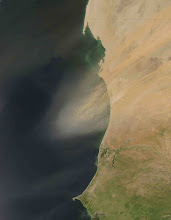
This remarkable image of the coast of West Africa is NASA's "photo of the week" (http://www.nasa.gov/). It shows a dust storm blowing over the Atlantic Ocean from Mauritania. If you could zoom in close enough, you'd see me on that little green peninsula near the bottom.

Actually, if you go to GoogleEarth, you can zoom in that close! When you do, find the airport on the west side of the penninsula. Due southeast from the airport, near the opposite shore, look for a large brown patch. That's Hann Park (the Dakar Zoo). Zoom in on that, and you can see the Dakar Academy campus across the street, near the top left corner of the park!

The campus has several buildings, a couple of parking lots, a basketball court, a sand lot, and, easiest to spot, a large grass-less, gray soccer field surrounded by trees. Near the bottom left corner of campus, there's a backwards-L-shaped building. That's my apartment house. I'm the guy on the roof waving at the camera.

Friday, September 28, 2007

"Will it be enough?"

In my post of August 28, I explained the hardships faced annually by many Senegalese subsistence farmers whose first fall harvests often aren't sufficient to meet the needs of their families.

In this photo of our Elementary Chapel service earlier today, you can see the stack of bags of rice and beans--over 2-½ tons--collected by our K-12 students. Tomorrow, a small group of students and staff will deliver the staples to suffering villagers.

"Will it be enough?" asked one of my fourth graders. I had to be honest. "No," I told her, "it won't feed everyone, but it will help."

If you would like to help with similar efforts, send a donation to WorldVenture / 1501 W. Mineral Ave. / Littleton, CO 80120 / Attn: Special Project #6403-933 Famine Relief, or you can give online at www.WorldVenture.com.

Wednesday, September 19, 2007

Spiritual Power, not Electrical Power

In my past four years here, the months of August through November have been quite frustrating because of the almost daily power outages. (The first year was the worst—I was teaching computers. Imagine doing that with no electricity!)

This school year has been different. So far, we’ve lost power on campus only a handful of times, and for only a half hour or so each, instead of the typical 6-10 hour outages. Nearby neighborhoods, on the other hand, continue to go without power for extended periods. Though it's impossible to say for sure why, one plausible theory is that a high government official has moved into our neighborhood, and is making sure his home has consistent electrical service.

Well, a letter I read today indicates someone even more powerful has "moved into the neighborhood." I'll copy in portions of the letter below, but for it to make sense, you need a little background.

For about a third of our students, DA is home for three quarters of the year; they live in dorms on or near campus while their parents serve as missionaries in more remote parts of West Africa. Each dorm has a set of dorm parents—a married couple who care for the students during the school year. Dorm parents get one night off each week, and someone else from school fills in for them.

Dan (our middle school/high school principal) and his wife, Patty (our second grade teacher), fill in as “dorm relief parents” for the middle school boys each Monday night. Following a Senegalese tradition, Dan and the boys drink a tea called attayah [uh-TY-uh], the brewing and drinking of which is the centerpiece of evening fellowship in Senegal. It is often prepared outdoors. To make their attayah gatherings even more fun, the middle schoolers hold theirs on the roof (houses in Senegal have flat roofs).

In a letter to the boys’ parents, this week, Dan described the “incredible thing” he witnessed in the dorm Monday night. I reprint exerpts here, edited somewhat for clarity.

On a normal Monday evening, I take the boys on the roof for attayah and a devotion. Last night was no different, except that one of the boys asked if we could have an extended prayer time on the roof after the devotion. . . . As we ended our time on the roof, the rains began to come down, and WOW, did it pour, and then the power went out.

Shortly thereafter, the boys came to me and asked permission to all sleep in the living room. They cited two reasons. (1) With the power being out, it was cooler and (2) they wanted to continue their time in prayer.

By 9:00 P.M., every boy was in the living room and it was pitch black. They began to pray. They prayed for each other, for DA, for their parents, for their parents’ ministries, for the administration, for their dorm parents, for the Senegalese people, for God to crush Satan’s power in Senegal. They prayed and prayed and prayed.

Then they began to pray one-on-one with each other; each boy going to all of his dorm mates. Several of them even prayed with and for me. I was absolutely blown away. At around 10:00 P.M., the power suddenly came back on. Several of the boys got up and turned off all the lights while the others continued to pray. . . .

They prayed for the Holy Spirit to empower them to share the Gospel and to give them the courage to love each other and everyone they came in contact with. They prayed for strength, they prayed for God’s armor, they prayed for the Holy Spirit to take control of their lives. . . . They prayed for over two hours!

. . . Your children are . . . a bright light in our lives. . . . They are a testament to your loving affection and guidance. They are a testament to the power of the Holy Spirit. . . . They are a testament to what young boys can do for a world in need of God’s love. . . .

May God bless your day as your boys have blessed my night!

In His Service,

Dan


DA Wins Award

DA won an Exemplary School Program award from one of our accrediting organizations, the Association of Christian Schools International (ACSI), for our innovative and effective Student Outreach program. The following description (co-authored by yours truly) summarizes the program. Though the article looks long here, it's actually fills only a single published magazine page. And it's pretty inspiring.

Imagine . . .

  • You pour a foundation, make 1,600 bricks by hand, lay the walls, raise the roof, and worship with local Christians in the church you just built for them.
  • You visit several villages, presenting skits and puppet shows, and starting children’s Bible clubs.
  • You play soccer with a high school team, then present the school with dictionaries, textbooks, and soccer uniforms.
  • You hold two performances of mime and multi-language music, followed by an
    evangelistic film and a call to freedom in Christ by a local pastor.

Now imagine . . . you are in high school, you and fellow students did all of this, and more, in one weekend, and you financed it yourselves.

This real-life scenario gives only a taste of the varied ways that Dakar Academy DA) high school students use their diverse gifts to minis­ter to people in Sénégal through DA’s innova­tive Student Outreach Program. Other facets of the program include monthly visits to an or­phanage; soap and shoe drives for local minis­tries to street kids; and friendship evangelism at a large French high school near our campus.

What makes this program remarkable? The answers to that question fall into the following four categories.

Strategic Breadth

My Skills Count: The variety of activities staged in a single weekend—manual labor, visual arts, performing arts, healthcare, sports—enables virtually any high school student to participate meaningfully.

Multiple Sizes Fit All: This variety also broadens the impact: if one aspect of the outreach doesn’t touch a particular villager, another one probably does.

Participation Depth

Here I am Lord, Send Me: Outreach week­ends attract more students than can participate; we consistently must turn volunteers away. One recent outreach involved 87 students—over 66% of the high school student body!

Pay as You Go: The program is self-supporting. They are funded by collections taken at DA’s Sunday morning worship services, attended by dorm students, some teachers, day students, and their families.

Chips Off the Young Blocks: The program’s vision is rubbing off on elementary students! A class of fifth graders who recently took a field trip to deliver Operation Christmas Child gifts to preschool children were proud to be doing something “like the big kids.” They realized that, though young, they can serve others for Christ.

Community Impact

Christian Identity: Students and staff from DA have built five churches in Sénégal. Beyond providing shelter for worship services, churches are a “24/7” symbol of Christian presence in the community. This strengthens local Christians’ identification with the body of Christ, and provides non-Christians with a visible reminder of the call to new life in Christ.

Spiritual Harvest: Sometimes fruit appears quickly: eight villagers chose to follow Christ during one outreach. Within weeks of another outreach, eighteen people had joined their village’s church—enlarging the congregation by more than fifty percent! Prayers for an end to drought brought the largest rains in 20 years.

Clearing the Path: The novelty of our students’ presence “in the bush” naturally attracts crowds. Their joy and generosity break barriers. Sénégalese children’s pastors report that our programs have opened doors for ministry in villages where previously they were not per­mitted to work.

Passing it On: Some DA teams have helped train Sénégalese Christian workers how to minister through puppetry and drama, extending the effect of our teams’ work.

Expanding Horizons

We’re grateful God is using us—teaching and equipping us to share the gospel across cultures. We are now developing partnerships with churches and schools in the U.S. and Europe, to help their students “catch” the vision, and extend the reach of the gospel in Sénégal.

May we be faithful and may God’s kingdom grow!

Saturday, September 8, 2007

Photo Request

Have I ever given you copies of photos I've taken (especially of Africa), either by email or on CD? If so, please, please, please send copies of these photos back to me.

Why?
.
Because, when my laptop crashed last spring, I lost hundreds of photos documenting my life in Senegal, pictures that I had thought were being backed up daily to my school's server. I'm trying to reconstruct some of this record of my time here.

Thanks!

Tuesday, August 28, 2007

Famine Relief

As my previous post makes clear, I have no problem obtaining food; but that's not true for subsistence farmers in parts of Senegal this season.

North of Dakar, the rains came so late this year that the harvest failed, and some villages ran out of food for some of their livestock, losing them to starvation. Fortunately, the rains have begun, and surviving livestock can feed on the vegetation that is now growing. Meanwhile, some of the families' own food stocks are down so low that they eat only once a day.

How to Help. WorldVenture, one of Dakar Academy’s owning missions, has organized a relief effort to help these folks hold on until the harvest of the second planting, later this fall. If you'd like to help, you can send donations to WorldVenture / 1501 W. Mineral Ave. / Littleton, CO 80120 / Attn: Special Project #6403-933 Famine Relief. (You can also give online at www.WorldVenture.com.)

Saturday, August 25, 2007

How Much Does it Cost to Live in Dakar? What Do You Eat?

These are two of the most common questions people ask me. Today, I'll give you a "taste" of the answer to both questions.

Good Eats. I usually have cereal and juice for breakfast. One lunch this week I had the Senegalese version of fast food. Neighborhood Senegalese restaurants fix one meal each lunchtime. You provide your own large (mixing) bowl, and for the equivalent of 50-75 cents US, they fill it with an enormous serving of a traditional, rice-based dish. Fish and rice on Monday, chicken and rice on Tuesday, etc. On Friday, I had the beef offering--mildly spiced fried rice with chunks of beef mixed in, topped with deliciously pickled vegetables.

Otherwise, I've been alternating among several dishes my cook prepared for me (she comes every Thursday): chicken in a hot tomato-mushroom sauce, meatless chili, pizza, and meatloaf, along with rice, couscous, pasta, whole wheat rolls, and canned corn. Plus cranberry scones. Fresh fish is also plentiful here. Jealous yet?

Where's the Kroger's? As for cost of living, I just took my first trip to Le Caddie (the neighborhood market, or marché--pronounced mar-shay) since my return to Dakar. It's a mom-and-pop shop a couple of blocks from campus, owned and operated by a delightful Lebanese couple. (Many of the middle-class business owners in Dakar are Lebanese.) What I bought and how much I paid will give you a feel for the availability and cost of western foods.

  • 3 boxes of breakfast cereal (including 1 Kellog's Rice Krispies, 1 Quaker Cruesli, and 1 "Temmy's Bran Flakes," from Egypt)
  • 2 1-litre boxes of juice imported from France
  • 3 1-litre no-refrigeration-needed plastic bottles of skimmed milk from France
  • 1 litre olive oil
  • 3 28-oz cans of beans (white, red, black)
  • 1 medium can of mushrooms
  • 3 packages of facial tissues (Kimberly-Clark)
  • 1 packet (200g) of butter (French)
  • 1 pkg of napkins from the United Arab Emirates
  • 1 box of brown (cane) sugar (France)
  • 1 bag of white sugar, locally hand-packed in unlabeled bags
  • 1 pack of fresh pita bread, hand-packed in unlabeled bags

Total Cost: 30,760 cfa (West African francs), or approximately $60.00 US

Friday, August 24, 2007

The Procedure Failed, but the Patient Survived

In my post of a few minutes ago, I forgot to thank all of those who have asked after my brother. Though doctors were unable to place a stent, medications dissolved the blockage in his artery. He is home, is recovering very quickly, and is grateful for everyone's concern and well-wishes.

Back "Home" in Dakar

Return Trip. I arrived in Dakar last Saturday night after one of the smoothest trips I've ever taken. Ironically, no one checked for my visa upon my return. Though I had my usual pre-return blues (they begin after 4 weeks back in the States), it's good to be back "home."

Teaching. I've just completed the 1st week of my 5th year teaching at Dakar Academy. I've always enjoyed the students here, but this appears to be the nicest crop yet. This semeseter, my responsibilities include:
  • Elementary School music: grades K-5, meeting 2x per week for 30 minutes each
  • Middle School music: grades 6-8, meeting 2x per week for 45 minutes each
  • Chamber Choir: 9 high school students selected by audition, 2x per week for 45 minutes each.
  • Overseeing Elementary Chapel (speaking and leading music, and finding others to do so)

This week I invented a musical game that the 3-6th graders really enjoyed.

Campus. The picture above is an old one, but shows an area of campus largely unchanged since I took it: the elementary school building (6 classrooms, a small kitchen, two bathrooms, and in the middle, the 2-story auditorium where I teach) and elementary playground.

Weather. The weather is always noteworthy here, even if it's weather as usual. As expected at this time of year, it's hot and humid. Thankfully, the power has stayed on for a whole week, so I've had the benefit of my new (used) air conditioner at night. It's also been cloudy. We had a welcome downpour today, wiping the dust off the leaves and washing much of the the humidity out of the air (and turning High School PE class soccer games into a mudbowl).

I would not be able to take this same picture today, because a new, 3-story classroom building covers the spot where I stood to snap the shot. In addition to the badly needed additional classroom space, the bottom floor of this new structure provides a great benefit: a shady, breezy, open area for lunchtimes and other large gatherings.

Birders Alert. I awoke to what I believe was the sound of an owl in the middle of the night earlier this week. A colleague thinks she saw one on campus recently. I've never seen an African owl, but perhaps I'll be able to post a picture of one here someday.

Want to Always Know the Latest? If you'd like to be notified whenever I publish a new post, click "Subscribe to Posts: (Atom)" at the bottom of the page.

Friday, August 17, 2007

Still in the US, still in the US, still in the USSA

Those old enough to remember such things will be able to deduce from from the title of this entry that I've been listening to Beatles albums lately.

I'm still in Michigan. I was to have left for Senegal on Tuesday Aug 7. Visa problems (long story) prevented my boarding the plane. After several phone calls to Dakar and several days of work by an Air France representative, we got things worked out, and my departure was rescheduled for Sunday, Aug 12, but...that afternoon, my brother came home from exercising with symptoms that sounded ominously similar to ones I had 22 months ago. I called 911, and he was rushed to the hospital, treated in transit for, yes, a heart attack.

He's back home now, doing well. He received excellent treatment, delivered cheerfully and professionally by University of Michigan Health System staff, and was himself a model patient. His prognosis is very good. Family, neighbors and other friends have been very supportive (both to him and to me). And, despite some frustration at being denied entrance to my first plane, I'm grateful I was still here 5 days later to recognize the symptoms, and I'm grateful it was a "minor" heart attack.

I am now scheduled to return to Dakar tomorrow (Friday the 17th), leaving him in the good hands of his daughter, who came from out of state, and other relatives and friends in the area.

When I arrive in Senegal Saturday evening, I will have missed the first two days of school, two days of annual orientation, and several days of last-minute prep. Fortunately, I often teach best when I'm improvising. I'm not looking foward to the heat and humidity, but hope it will help me lose some of the 30 lbs I've gained in the past 9 months!

I do look forward to using this blog to keep family and friends updated more often than I have in the past. Suggestions are welcome. (Yes, I know, add more photos. I'll work on that once I get settled in again in Dakar.)

Tuesday, July 31, 2007

First Blog Entry: This is a test of the Sappington Broadcast System...


Welcome to my blog, where I'll be posting occasional reflections on--and pictures of--my life in Senegal. I'm new to this, so it will take a while for me to develop features my family and friends will find helpful.

The photo above is of several friends at Dakar Academy--two of our guards, and one of our former teachers holding his youngest son. (Photo courtesy of Sara Lyn Page)